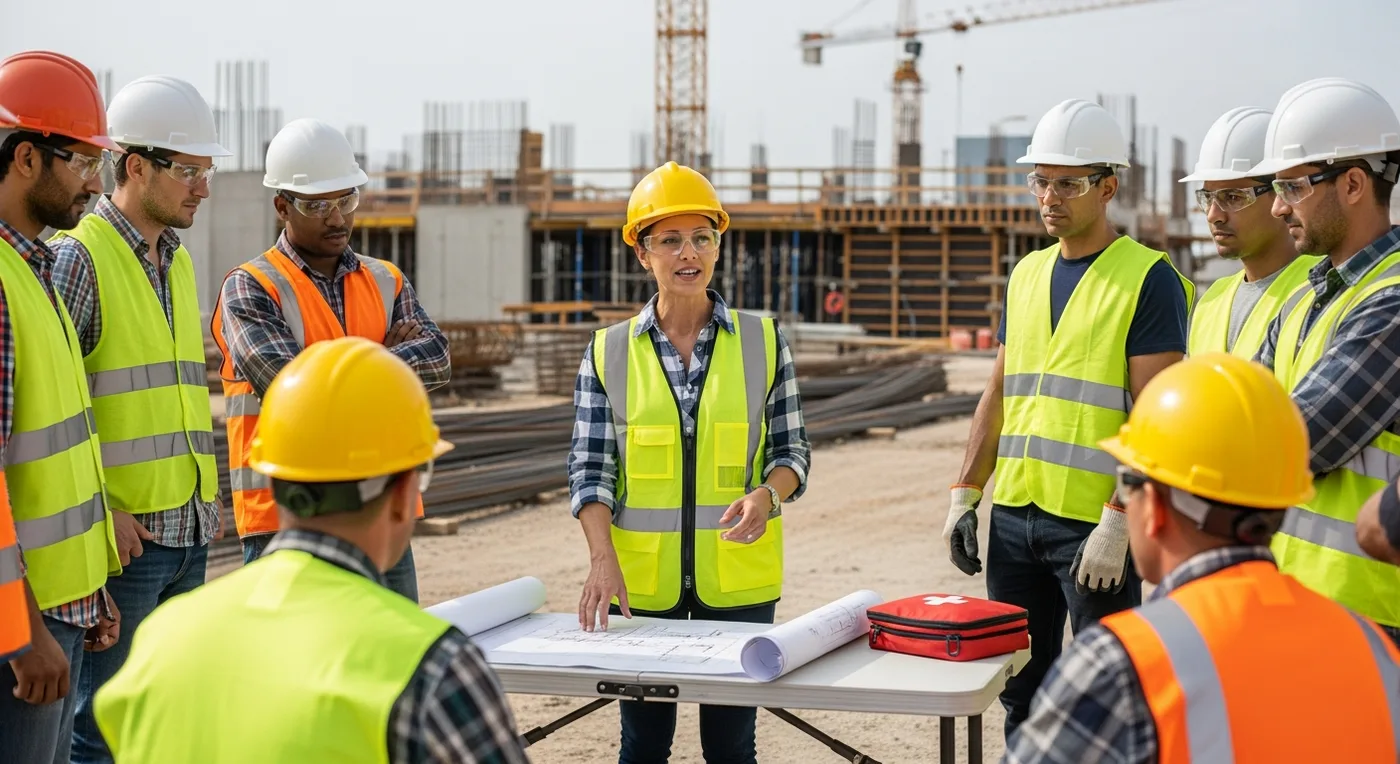
What is a toolbox talk?
A toolbox talk — also called a tailgate meeting, tailgate talk, or safety meeting — is a brief, informal safety briefing delivered to workers before a shift or before a specific task begins. Typically lasting 5–15 minutes, a toolbox talk covers a single safety topic relevant to the day's work: a particular hazard, a regulatory requirement, a recent near miss, or a seasonal safety concern.
The toolbox talk format originated in the construction industry — historically delivered at the toolbox on the back of a pickup truck — but is now widely used in general industry, utilities, logistics, manufacturing, and any sector where supervisor-led safety briefings are practical.
What does OSHA say about toolbox talks?
OSHA does not have a regulation specifically named "toolbox talks," but safety meetings and employee training are required under multiple OSHA standards:
- OSHA 1926.21 — Construction Safety: "The employer shall instruct each employee in the recognition and avoidance of unsafe conditions and the regulations applicable to his work environment to control or eliminate any hazards or other exposure to illness or injury." Toolbox talks are the most common way construction employers document compliance with this requirement.
- OSHA 1910.132 — Personal Protective Equipment: Employers must provide training on PPE — when it's required, how to put it on, adjust, wear, and take it off, and its limitations. Toolbox talks are an effective format for this training.
- OSHA 1910.1200 — Hazard Communication: Workers must be trained on chemical hazards in their work area. Toolbox talks on SDS reviews, chemical handling, and spill response count toward HazCom training.
- OSHA General Duty Clause — Regular documented safety meetings provide evidence that an employer is taking reasonable steps to maintain a safe workplace.
How often should toolbox talks be held?
OSHA does not specify a mandatory frequency for toolbox talks in most standards. Industry best practice and the expectation of most OSHA compliance officers is:
- Construction — weekly at minimum; many employers run daily tailgate meetings before each shift
- General industry — monthly at minimum; weekly is best practice for high-hazard environments
- High-hazard operations — before each instance of the hazardous task (confined space, hot work, LOTO operations)
The more frequently you hold toolbox talks, the shorter each one can be — a 5-minute daily tailgate meeting is more effective than a 45-minute monthly lecture.
What makes a good toolbox talk?
An effective toolbox talk has a few key characteristics:
- One topic — focus on a single hazard or subject; trying to cover too much through a guided workflow means nothing is retained
- Relevant to today's work — the best toolbox talks address the specific hazards of that day's tasks and site conditions
- Two-way conversation — ask workers questions, invite them to share experiences with the hazard; this improves retention and uncovers site-specific issues
- Short — 5–15 minutes maximum; workers lose attention after 15 minutes in a standing format
- Documented — attendance sheet with signatures, date, topic covered, and facilitator name
How to document toolbox talks for OSHA
OSHA compliance officers frequently ask for training records during inspections. Undocumented toolbox talks are effectively undocumented training. Every toolbox talk should generate a record that includes:
- Date and time of the meeting
- Topic covered
- Name and signature of the facilitator
- Names and signatures of all attendees
- Location (jobsite/facility)
Assessment First generates a complete digital toolbox talk record with timestamped crew signatures, exportable as a PDF. Every record is stored permanently and searchable by date, topic, and crew member.
OSHA toolbox talk topics for common industries
The following topics are among the most commonly required and most impactful for US employers:
Construction
- Fall protection — 100% tie-off, anchor points, leading edge fall hazards
- Struck-by — PPE, exclusion zones, crane and rigging awareness
- LOTO — authorized vs affected employee roles, written procedures
- Caught-in/between — machinery guards, trench shoring, excavation sloping
- Heat illness prevention — hydration, shade, buddy system, heat illness recognition
General Industry
- Hazard communication and SDS — right-to-know, container labelling
- PPE — selection, inspection, and care of respirators, safety glasses, gloves
- Ergonomics — manual materials handling, workstation setup, stretch breaks
- Emergency action plan — evacuation routes, assembly points, fire extinguisher use
- Slips, trips, and falls — housekeeping, footwear, spill response
Digital toolbox talks with Assessment First
Assessment First provides pre-built toolbox talk scripts for OSHA's most common hazard categories. Run the meeting on your phone or tablet, collect crew signatures digitally, and store the record permanently. Your first toolbox talk is free — current access terms shown before registration.